In today’s digital world, abbreviations help people communicate faster. One term that often appears in chats, comments, and social media conversations is ASL.
Many users search for “ASL meaning in text” because the abbreviation can have different meanings depending on the situation.
If you have seen someone type ASL in a message, you may wonder what they are asking. The answer is not always the same. In some cases, it refers to age, sex, and location. In others, it stands for American Sign Language.
Understanding the context is important because the meaning changes across platforms and conversations. This guide explains the different meanings of ASL, where it came from, and how people use it today.
Whether you use WhatsApp, Instagram, TikTok, Snapchat, or dating apps, knowing the meaning of ASL can help you avoid confusion and respond correctly.
Meaning & Definition of ASL in Text
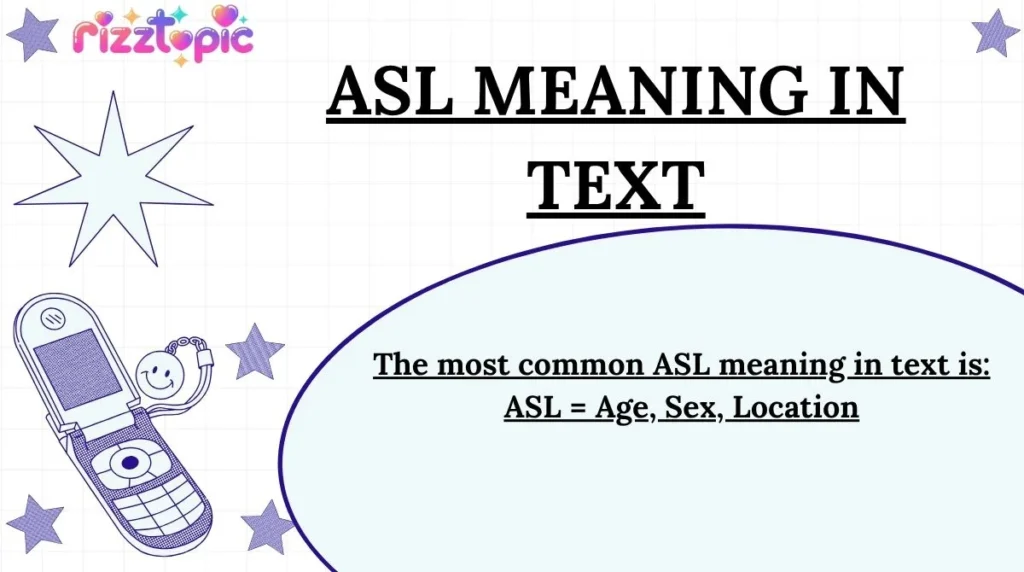
The most common ASL meaning in text is:
ASL = Age, Sex, Location
People use it to quickly ask basic information about another person. It became popular in online chat rooms and messaging platforms.
Example
- Person 1: Hi!
- Person 2: ASL?
- Person 1: 22, Female, New York.
In this example, the person is asking:
- How old are you?
- What is your gender?
- Where do you live?
Secondary Meaning
ASL can also mean:
American Sign Language
This is the visual language used by many deaf and partially deaf individuals in North America.
Example
- “I’m learning ASL this year.”
- “She communicates using ASL.”
Because ASL has multiple meanings, context is the key to understanding what someone means.
Background & Origin of ASL
The abbreviation ASL became popular during the early days of internet chat rooms in the 1990s. At that time, users wanted a fast way to learn basic information about the people they were talking to online.
Chat platforms such as early messaging services and internet forums encouraged short forms. Instead of asking several questions, users could simply type “ASL?” and get quick answers.
As online communication evolved, the abbreviation spread across social networking sites, instant messaging apps, and gaming communities. Even though internet culture has changed, ASL remains recognizable to many users.
The second meaning, American Sign Language, has a much older history. It developed in the early nineteenth century and became one of the most widely used sign languages in the world.
Today, both meanings coexist, which is why context matters when reading or sending messages.
Usage in Different Contexts
ASL can mean different things depending on where and how it is used.
Casual Chat
In personal conversations, ASL usually means Age, Sex, Location.
Examples
- ASL?
- What’s your ASL?
- Can I know your ASL?
Social Media
Users may mention ASL when discussing internet culture or meeting new people online.
Examples
- “Nobody asks ASL anymore.”
- “Remember old chat rooms and ASL questions?”
Educational Context
ASL often refers to American Sign Language.
Examples
- “I’m taking an ASL course.”
- “She teaches ASL.”
Professional Context
In professional environments, ASL may represent technical terms depending on the industry. The intended meaning is usually clear from the discussion.
Meanings Across Platforms
On WhatsApp, ASL commonly means Age, Sex, Location.
Example
- “Hey, ASL?”
On Instagram, ASL may appear in direct messages or comments. It can also refer to American Sign Language in educational content.
TikTok
TikTok creators frequently use ASL when discussing sign language, accessibility, or communication tips.
Snapchat
On Snapchat, ASL is often used when strangers start conversations and want quick personal details.
Gaming Platforms
Many gamers still use ASL to ask basic information about teammates or new online friends.
Other Meanings of ASL in Different Fields
ASL is not limited to texting.
American Sign Language
The most recognized non-text meaning.
Aviation
In aviation, ASL can mean:
Above Sea Level
Pilots and aviation professionals use this measurement for altitude.
Medical Industry
Some healthcare organizations use ASL as an abbreviation in specific records or reports.
Technology
Technical fields may use ASL as an acronym for specialized terms depending on the industry.
Always check the surrounding context to determine the intended meaning.
Common Misconceptions & Mistakes
Many people misunderstand ASL because it has multiple definitions.
Common Mistakes
- Assuming it always means American Sign Language.
- Assuming it always means Age, Sex, Location.
- Using it in professional communication without clarification.
- Responding incorrectly because of missing context.
Example
Incorrect:
- Person: “I’m studying ASL.”
- Reply: “I’m 24, Male, London.”
Correct:
- Reply: “That’s great. How long have you been learning American Sign Language?”
Context helps avoid confusion.
Similar Terms & Alternatives
| Term | Meaning |
|---|---|
| ASL | Age, Sex, Location |
| A/S/L | Same meaning with slashes |
| BIO | Basic personal information |
| Intro? | Asking someone to introduce themselves |
| F, M | Female or Male |
| DM | Direct Message |
| IRL | In Real Life |
| BRB | Be Right Back |
These abbreviations are commonly used in online conversations.
How to Respond to ASL
If someone asks ASL, you can answer briefly and naturally.
Chat Examples
- “21, Female, Chicago 😊”
- “25, Male, Lahore 👍”
- “19, Student, Karachi 😄”
- “23, Female, Toronto 🌟”
If you do not want to share personal details, you can reply politely.
Examples
- “I’d rather not share that.”
- “Let’s just chat first.”
- “I keep personal details private.”
Differences From Similar Words
ASL is different from other internet abbreviations because it asks for personal information.
| Term | Purpose |
|---|---|
| ASL | Ask age, sex, and location |
| WYD | Ask what someone is doing |
| HMU | Invite someone to contact you |
| IDK | Express not knowing something |
| IMO | Share an opinion |
Unlike these abbreviations, ASL focuses on identifying basic details about a person.
Relevance in Online Conversations & Dating Apps
Although ASL is less common than it was in the early internet era, it still appears on messaging platforms and dating apps.
Some users ask ASL to learn basic details before continuing a conversation. Others avoid using it because modern platforms already display profile information.
On dating apps, users may prefer asking questions naturally instead of using abbreviations. However, ASL remains familiar to many internet users.
Common Examples
- “ASL before we continue?”
- “What’s your ASL?”
- “Can I know your ASL?”
The phrase is still recognized across many online communities.
Popularity & Trends Over Time
The popularity of ASL has changed significantly over the years.
During the late 1990s and early 2000s, ASL was one of the most common internet abbreviations. Chat rooms, online forums, and instant messaging services helped it become widely known.
As social media evolved, people relied less on abbreviations because profiles often displayed age, location, and personal information automatically.
At the same time, interest in American Sign Language increased through educational content, accessibility awareness, and social media videos. This created a second wave of searches for ASL.
Today, searches for “ASL meaning in text” remain popular because users encounter both meanings online and want clarification.
FAQs
What does ASL mean in texting?
In texting, ASL usually means Age, Sex, Location.
Does ASL always mean Age, Sex, Location?
No. It can also mean American Sign Language depending on the context.
What should I reply when someone asks ASL?
You can share your age, gender, and location or politely decline.
Is ASL still used today?
Yes, although it is less common than during the early internet era.
What does ASL mean on Snapchat?
It often means Age, Sex, Location when used in chats.
What does ASL mean on TikTok?
Many TikTok users use ASL to refer to American Sign Language.
Is ASL appropriate for professional communication?
Generally, no. It may cause confusion unless the meaning is clearly defined.
Why do people search for ASL meaning in text?
Because the abbreviation has multiple meanings and can be confusing without context.
Conclusion
Understanding the ASL meaning in text is important because the abbreviation has more than one definition. In most online chats, ASL stands for Age, Sex, Location and is used to learn basic information about another person.
At the same time, ASL can also mean American Sign Language, especially in educational and accessibility-related discussions. The surrounding conversation usually makes the intended meaning clear.
While ASL is not as common as it once was, it remains a recognizable part of internet culture. People still use it in messaging apps, social media platforms, gaming communities, and online conversations.
The next time you see ASL in a text, look at the context first. Doing so will help you understand the message correctly and respond with confidence.