People often come across internet slang while chatting online and wonder what certain abbreviations mean. One of the most common abbreviations seen in messages and social media comments is IDC.
The term is widely used in texting because it is short, simple, and easy to type. Many people search for its meaning when they receive it in a conversation and are unsure whether it sounds rude, casual, or friendly.
Understanding internet abbreviations can help avoid confusion and make online communication easier. Knowing what IDC means also helps you understand the tone of a conversation more accurately.
In this guide, you’ll learn the meaning of IDC in text, where it came from, how people use it across different platforms, and how to respond when someone sends it to you.
Meaning & Definition of IDC
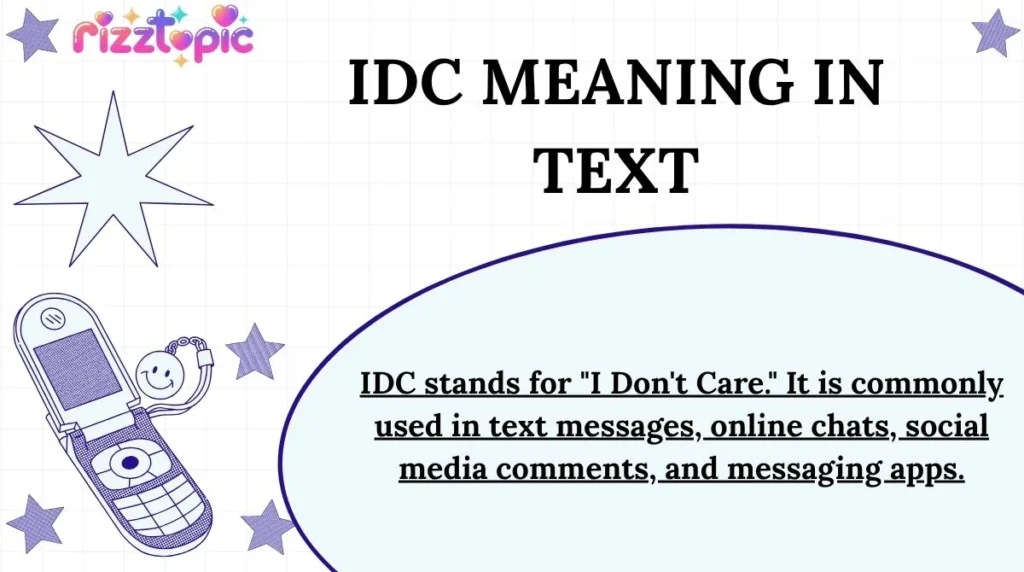
IDC stands for “I Don’t Care.” It is commonly used in text messages, online chats, social media comments, and messaging apps.
The primary meaning is straightforward. When someone says IDC, they are expressing that something is not important to them or that they have no strong opinion about a topic.
For example:
- “Where do you want to eat?”
- “IDC, you choose.”
In this example, the person is comfortable with any choice.
However, IDC can also have a secondary meaning depending on the tone of the conversation. Sometimes it can sound dismissive, annoyed, or uninterested.
Examples:
- “They keep talking about it.”
- “IDC anymore.”
Here, the abbreviation suggests frustration or a lack of interest.
Common meanings include:
- I have no preference.
- It doesn’t matter to me.
- I’m not interested.
- I’m tired of discussing it.
- I’m emotionally detached from the topic.
Because tone is difficult to understand through text, the meaning often depends on the context of the conversation.
Background & Origin of IDC
IDC became popular during the rise of internet chat rooms, online forums, and SMS texting in the late 1990s and early 2000s.
At that time, mobile phones had character limits and slower keyboards. Users shortened common phrases into abbreviations to save time and effort.
Popular abbreviations from that era included:
- LOL (Laugh Out Loud)
- BRB (Be Right Back)
- OMG (Oh My God)
- IDC (I Don’t Care)
As social media platforms grew, IDC spread beyond text messaging and became part of everyday internet language.
Today, it is used by people of all ages, especially younger users who frequently communicate through apps and social platforms.
The abbreviation remains popular because it quickly expresses indifference without requiring a full sentence.
Usage in Different Contexts
IDC can mean different things depending on where and how it is used.
Casual Chat
In friendly conversations, IDC often means someone is flexible.
Examples:
- “Which movie should we watch?”
- “IDC, pick one.”
Social Media
People use IDC in comments and captions to express opinions or indifference.
Examples:
- “IDC what people think.”
- “IDC if it’s unpopular.”
Gaming Communities
Gamers use IDC to show they are unconcerned about outcomes or opinions.
Examples:
- “IDC who wins.”
- “IDC about rankings.”
Workplace Conversations
Professional use is less common because IDC can sound rude.
Instead, people might say:
- “I have no preference.”
- “Either option works for me.”
Using IDC in business communication can sometimes create misunderstandings.
Meanings Across Platforms
On WhatsApp, IDC usually means the sender has no preference or interest.
Example:
- “Want pizza or burgers?”
- “IDC.”
Instagram users often include IDC in captions.
Examples:
- “IDC what others think.”
- “IDC about the drama.”
TikTok
TikTok creators frequently use IDC in video captions and comments.
Examples:
- “IDC if this trend is over.”
- “IDC, I’m posting it anyway.”
Snapchat
On Snapchat, IDC often appears in quick conversations.
Examples:
- “Where should we meet?”
- “IDC 😂”
The meaning stays mostly the same across platforms, but the tone changes depending on the conversation.
Other Fields Where IDC Has Different Meanings
Although IDC usually means “I Don’t Care” in texting, it has several other meanings.
| Field | IDC Meaning |
|---|---|
| Technology | International Data Corporation |
| Medical | Implantable Drug Carrier |
| Business | Industrial Development Corporation |
| Aviation | Integrated Display Computer |
| Telecommunications | International Direct Calling |
When reading IDC outside of social media or texting, always consider the context.
For example:
- In technology articles, IDC may refer to International Data Corporation.
- In aviation documents, IDC may refer to Integrated Display Computer.
Common Misconceptions & Mistakes
Many people misunderstand IDC because tone can be difficult to interpret in text.
Common mistakes include:
Assuming It Is Always Rude
IDC can sound harsh, but often it simply means someone has no preference.
Using It in Formal Emails
Professional communication usually requires more polite wording.
Instead of:
- “IDC.”
Try:
- “Either option works for me.”
Confusing It With IDK
People often mix up IDC and IDK.
- IDC = I Don’t Care
- IDK = I Don’t Know
These abbreviations have completely different meanings.
Similar Terms & Alternatives
The following expressions have meanings similar to IDC.
| Term | Meaning |
|---|---|
| IDK | I Don’t Know |
| NVM | Never Mind |
| Whatever | No preference |
| Doesn’t Matter | Not important |
| Up to You | Your choice |
| Fine by Me | I agree with any option |
| No Big Deal | Not important |
These alternatives can sometimes sound friendlier than IDC.
How to Respond to IDC
Your response depends on the situation and tone.
If someone genuinely has no preference:
Example 1
- You: “Pizza or burgers?”
- Them: “IDC.”
- You: “Okay, let’s get pizza. 🍕”
Example 2
- You: “What time should we meet?”
- Them: “IDC.”
- You: “Let’s meet at 6 PM.”
Example 3
- You: “Which movie?”
- Them: “IDC 😂”
- You: “Great, I’ll choose one.”
Example 4
- You: “Are you okay?”
- Them: “IDC anymore.”
- You: “You seem upset. Want to talk about it?”
Understanding the tone helps you respond appropriately.
Differences From Similar Words
IDC differs from many similar abbreviations.
IDC vs IDK
- IDC = I Don’t Care
- IDK = I Don’t Know
IDC vs Whatever
“Whatever” can sound sarcastic.
IDC is usually more direct.
IDC vs Up to You
“Up to You” sounds friendlier and more polite.
IDC can sometimes appear blunt.
IDC vs Doesn’t Matter
Both mean a lack of preference, but “doesn’t matter” often sounds softer.
Relevance in Online Conversations & Dating Apps
IDC is frequently used on dating apps and social platforms.
In dating conversations, it can have different meanings.
Positive examples:
- “IDC where we go.”
- “IDC what movie we watch.”
Negative examples:
- “IDC about dating right now.”
- “IDC if they reply.”
Because dating conversations rely heavily on tone, using IDC too often may make someone seem uninterested.
Many people prefer softer alternatives such as:
- “I’m okay with either.”
- “You can choose.”
- “Whatever works for you.”
These responses feel more engaging and friendly.
Popularity & Trends Over Time
IDC has remained popular for more than two decades.
Google search interest often increases when new users encounter internet slang and want quick explanations.
Several factors contribute to its continued popularity:
- Growth of messaging apps.
- Increased social media use.
- Short-form communication habits.
- Popularity among younger generations.
The abbreviation is commonly used on:
- TikTok
- Snapchat
- Discord
- X (formerly Twitter)
Despite the emergence of new slang, IDC continues to be one of the most recognized internet abbreviations.
FAQs
What does IDC mean in text messages?
IDC usually means “I Don’t Care.” It expresses a lack of preference, interest, or concern.
Is IDC rude?
Not always. It depends on the context and tone. Sometimes it simply means someone has no preference.
What is the difference between IDC and IDK?
IDC means “I Don’t Care,” while IDK means “I Don’t Know.”
What does IDC mean on Snapchat?
On Snapchat, IDC generally means the same thing as in texting: “I Don’t Care.”
What does IDC mean on Instagram?
Instagram users often use IDC in captions and comments to show confidence or indifference.
Can IDC be used professionally?
It is generally not recommended because it can sound dismissive or unprofessional.
What are friendlier alternatives to IDC?
You can use:
- Up to you
- Either works
- No preference
- Fine by me
- Doesn’t matter
Conclusion
IDC is one of the most common abbreviations used in modern digital communication. In most situations, it simply means “I Don’t Care” and indicates that someone has no strong preference or opinion.
The abbreviation became popular through texting culture and continues to be widely used on social media platforms, messaging apps, and online communities.
While it is usually harmless, the tone can sometimes make it sound rude or dismissive.
Understanding the context is important when interpreting IDC. The same abbreviation can sound casual, friendly, frustrated, or indifferent depending on the conversation.
Whether you see it on WhatsApp, Instagram, TikTok, Snapchat, or a dating app, knowing the meaning of IDC helps you communicate more clearly and avoid misunderstandings in online conversations.