If you have received a message containing “IDM” and wondered what it means, you are not alone.
Many people search for IDM meaning in text because abbreviations are common in online chats, social media posts, and texting conversations.
The meaning of IDM can change depending on the situation. In casual messaging, it often has a completely different meaning than it does in technology, business, or academic fields.
This can make the abbreviation confusing for new users.
As texting culture continues to grow, short forms like IDM help people communicate faster. Understanding these abbreviations can help you avoid misunderstandings and keep up with online conversations.
In this guide, you’ll learn the meaning of IDM in text messages, its origin, different uses across platforms, alternative meanings, common mistakes, and how to respond when someone uses it.
Meaning & Definition of IDM
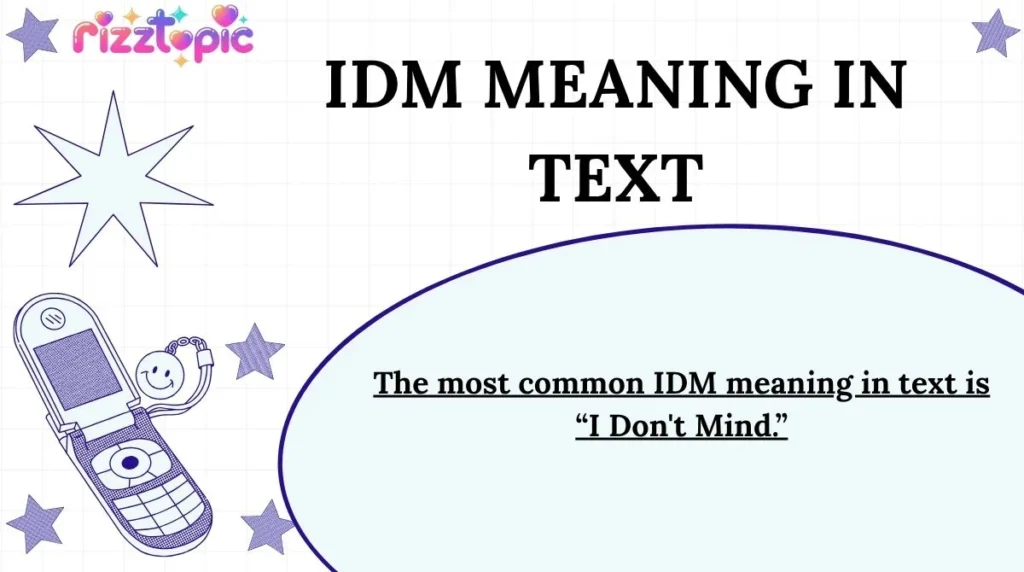
The most common IDM meaning in text is “I Don’t Mind.”
People use IDM when they want to show that they have no preference or are okay with a suggestion. It is a quick and friendly way to express flexibility in a conversation.
Primary Meaning
IDM = I Don’t Mind
Examples:
- “Do you want pizza or burgers?”
- “IDM, you choose.”
- “Can we meet later?”
- “IDM 😊”
In these examples, the sender is saying that either option is acceptable.
Secondary Meanings
Depending on the context, IDM may also stand for:
- Intelligent Dance Music
- Identity Management
- Integrated Data Management
- Information Data Management
- Institute of Development Management
The correct meaning depends entirely on the conversation and the topic being discussed.
Quick Examples
- “IDM where we go for dinner.”
- “IDM what movie we watch.”
- “IDM if you join us.”
- “IDM, sounds good!”
Background & Origin
The abbreviation IDM emerged from the rise of internet chat rooms, SMS texting, and online messaging platforms in the late 1990s and early 2000s.
As mobile phones became more popular, users started shortening common phrases to save time and reduce typing effort. Expressions such as:
- LOL (Laugh Out Loud)
- BRB (Be Right Back)
- IMO (In My Opinion)
- IDM (I Don’t Mind)
quickly became part of online communication.
The phrase “I don’t mind” itself has existed in English for centuries. However, the abbreviated form gained popularity through texting culture and social media communication.
Today, IDM is widely understood among frequent internet users and appears in messaging apps, gaming communities, online forums, and social networks.
The abbreviation continues to be used because it is short, easy to type, and clearly communicates agreement without requiring a lengthy response.
Usage in Different Contexts
The meaning of IDM can vary depending on where it is used.
Casual Chat
In personal conversations, IDM usually means “I Don’t Mind.”
Examples:
- “Want to call later?”
- “IDM.”
- “Should we leave now?”
- “IDM.”
Social Media
Users often comment IDM when responding to polls, stories, or questions.
Examples:
- “Which outfit looks better?”
- “IDM, both look great.”
Gaming
Gamers use IDM to show they have no preference about maps, teams, or strategies.
Example:
- “Which map should we play?”
- “IDM.”
Workplace Communication
In professional conversations, IDM may sometimes refer to Identity Management or Integrated Data Management.
Example:
- “The IT team is updating the IDM system.”
Context is important because the meaning changes dramatically between casual and professional environments.
Meanings Across Platforms
On WhatsApp, IDM almost always means I Don’t Mind.
Example:
- “Can we meet at 7?”
- “IDM.”
Users may use IDM in comments, direct messages, and story replies.
Example:
- “Should I post this photo?”
- “IDM, it looks good.”
TikTok
TikTok users commonly use IDM in comment sections when discussing trends or opinions.
Example:
- “Which version is better?”
- “IDM honestly.”
Snapchat
Snapchat conversations tend to be quick and informal, making IDM a popular response.
Example:
- “Want to snap later?”
- “IDM 😊”
Across these platforms, the texting meaning remains the most common interpretation.
Other Fields Where IDM Is Used
IDM does not always mean “I Don’t Mind.” Several industries use the abbreviation differently.
Technology
Identity Management (IDM)
A system used to manage user identities and access permissions.
Data Management
Integrated Data Management
A framework for organizing and handling information.
Music
Intelligent Dance Music
A genre of electronic music known for experimental sounds.
Education
Institute of Development Management
An educational institution or training organization in some regions.
Business
Information Data Management
Processes used to organize and protect business data.
When reading IDM outside social media or texting, always consider the surrounding context.
Common Misconceptions & Mistakes
Many people misunderstand IDM because abbreviations can have multiple meanings.
Common Mistakes
Mistake 1: Assuming one meaning everywhere
IDM in a text message usually means “I Don’t Mind,” but in technology discussions it may mean Identity Management.
Mistake 2: Confusing IDM with IDK
- IDM = I Don’t Mind
- IDK = I Don’t Know
These abbreviations communicate completely different ideas.
Mistake 3: Using IDM when a stronger opinion exists
If you actually have a preference, saying IDM may confuse others.
Example
Wrong:
- “IDM, but I really want pizza.”
Better:
- “I’d prefer pizza.”
Understanding the context helps avoid confusion.
Similar Terms & Alternatives
| Abbreviation | Meaning | Usage |
|---|---|---|
| IDM | I Don’t Mind | No preference |
| IDK | I Don’t Know | Unsure |
| IMO | In My Opinion | Sharing opinion |
| NVM | Never Mind | Ignore previous statement |
| OK | Okay | Agreement |
| Sure | Agreement | Positive response |
| Either Way | No preference | Flexible choice |
| Up to You | Your decision | Giving choice |
These alternatives can often replace IDM depending on the conversation.
How to Respond to IDM
When someone says IDM, they are usually telling you that they have no strong preference.
Appropriate Responses
- “Great, let’s go with option A.”
- “Okay, I’ll decide then.”
- “Perfect, thanks!”
- “Sounds good.”
Chat Examples
Example 1
Person A: “Movie or dinner first?”
Person B: “IDM 😊”
Person A: “Let’s do dinner first.”
Example 2
Person A: “Should we meet at 6 or 7?”
Person B: “IDM.”
Person A: “Okay, 7 works.”
Example 3
Person A: “Blue shirt or black shirt?”
Person B: “IDM 😄”
Person A: “Black it is.”
Example 4
Person A: “Call now?”
Person B: “IDM.”
Person A: “I’ll ring you in five minutes.”
Differences From Similar Words
Although IDM means “I Don’t Mind,” it differs from several similar expressions.
IDM vs IDK
- IDM = No preference
- IDK = No knowledge
IDM vs Sure
- IDM suggests neutrality.
- Sure suggests active agreement.
IDM vs Whatever
- IDM sounds polite.
- Whatever can sound dismissive.
IDM vs Up to You
- Both indicate flexibility.
- Up to You gives decision-making power directly to the other person.
These subtle differences can affect the tone of a conversation.
Relevance in Online Conversations & Dating Apps
IDM appears frequently in online conversations because it keeps replies short and efficient.
On dating apps, users often use IDM when discussing:
- Meeting locations
- Activities
- Food choices
- Conversation topics
Examples:
- “Coffee or dinner?”
- “IDM 😊”
- “Want to meet Saturday or Sunday?”
- “IDM, either works.”
The abbreviation helps maintain a relaxed and easy-going tone.
However, overusing IDM may sometimes make a person seem uninterested because they never express a preference.
A balanced approach is often best.
Popularity & Trends Over Time
The popularity of IDM grew alongside texting, instant messaging, and smartphone usage.
In the early internet era, abbreviations became essential because mobile keyboards were slower and SMS character limits existed.
Today, messaging apps allow unlimited text, yet abbreviations remain popular because they are convenient.
Google search interest in terms like:
- IDM meaning in text
- IDM abbreviation
- What does IDM mean
- IDM text meaning
continues to appear as new users encounter the term online.
Social media platforms, gaming communities, and messaging apps have helped keep the abbreviation relevant over time.
While newer slang terms appear regularly, IDM remains a useful and widely recognized abbreviation.
FAQs
What does IDM mean in texting?
In texting, IDM usually means “I Don’t Mind.”
Is IDM positive or negative?
It is generally neutral or positive because it shows flexibility.
What does IDM mean on Snapchat?
On Snapchat, it typically means “I Don’t Mind.”
What does IDM mean on Instagram?
Most Instagram users use IDM to mean “I Don’t Mind.”
Is IDM the same as IDK?
No.
- IDM = I Don’t Mind
- IDK = I Don’t Know
Can IDM have different meanings?
Yes. In technology and business, it may refer to Identity Management or Integrated Data Management.
When should I use IDM?
Use it when you genuinely have no preference between options.
Conclusion
IDM is a simple abbreviation that most commonly means “I Don’t Mind” in text messages, chats, and social media conversations. It is used when someone has no strong preference and is comfortable with different options.
Although the texting meaning is the most popular, IDM can also represent several technical, business, educational, and music-related terms. Understanding the surrounding context is the key to identifying the correct meaning.
The abbreviation remains widely used because it is short, convenient, and easy to understand. Whether you see it on WhatsApp, Instagram, TikTok, Snapchat, or in a casual text message, IDM usually signals flexibility and agreement.
Now that you know the full IDM meaning in text, you’ll be able to recognize it instantly and respond confidently in future online conversations.