Text to text meaning is a common phrase that appears in communication, education, technology, and online conversations.
Many people search for this term because they want to understand how one text connects, relates, or compares to another text.
The phrase is widely used in schools, content analysis, digital communication, and social media discussions. Depending on the situation, it can have different meanings, which often creates confusion for new users.
Understanding text to text meaning can help improve reading skills, communication abilities, and content interpretation. It is a useful concept that appears in both casual and professional environments.
In this guide, you’ll learn the definition, origin, usage, platform-specific meanings, common mistakes, and practical examples of text to text meaning in simple language.
Meaning & Definition of Text to Text
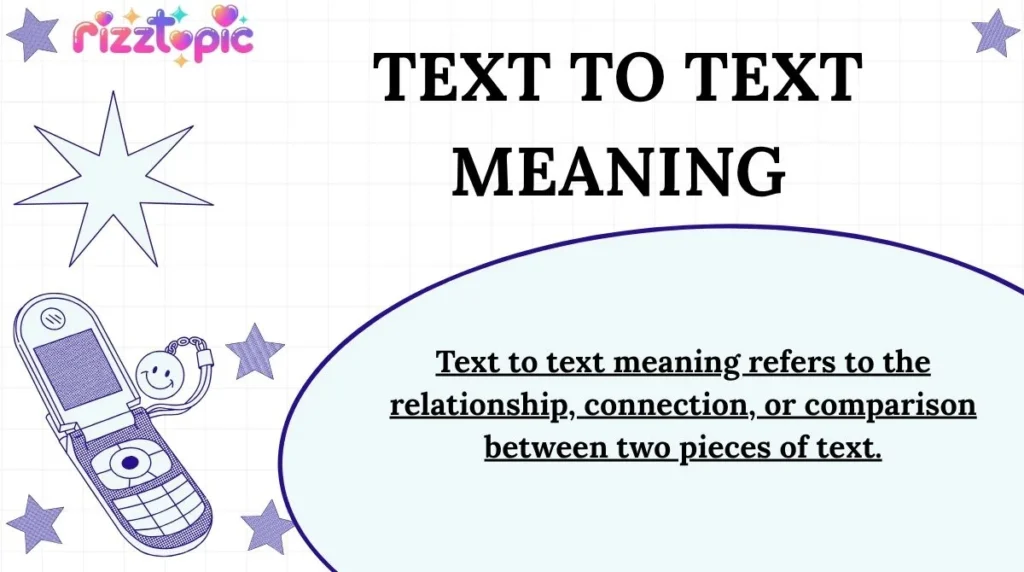
Text to text meaning refers to the relationship, connection, or comparison between two pieces of text. It involves identifying similarities, differences, themes, ideas, or messages shared by different written materials.
In education, text to text connections occur when readers compare one book, article, story, or document with another. This helps readers understand information more deeply and improve comprehension.
The primary meaning focuses on comparing content between written sources. For example, a student may compare the themes of two novels and identify common ideas.
The secondary meaning appears in digital communication and technology. In this context, text to text can describe the process of converting, transferring, or linking one text-based message to another.
Quick Examples
- Comparing two novels with similar themes.
- Linking one article to another article.
- Referencing a previous message in a chat.
- Analyzing similarities between social media posts.
- Connecting information from multiple sources.
Background & Origin of Text to Text
The concept of text to text connections became popular in educational literacy programs. Teachers used it as a reading strategy to help students engage more deeply with written materials.
The idea originated from reading comprehension techniques that encourage readers to connect information from different texts. Educational researchers found that readers understand content better when they compare and relate texts.
As technology evolved, the phrase gained additional meanings. Digital communication, online messaging, and content analysis introduced broader uses of the term.
Today, text to text is recognized across education, social media, communication platforms, and technology industries. Its meaning continues to expand as online interactions become more common.
Usage in Different Contexts
The meaning of text to text changes depending on where it is used.
In Education
Students compare books, articles, and stories to identify shared ideas and themes.
Example:
- Comparing a historical novel with a history textbook.
- Finding common lessons in two short stories.
In Chat Conversations
People may refer to previous messages and connect one text with another.
Example:
- “Your new message relates to the text you sent yesterday.”
In Content Writing
Writers compare sources to ensure consistency and accuracy.
Example:
- Comparing two research articles before writing a report.
In Technology
Text-to-text processes may involve transferring textual data between systems or applications.
Example:
- Moving content from one document to another.
Meanings Across Platforms
On WhatsApp, text to text often refers to message exchanges between users. It can also describe comparing current messages with previous conversations.
Example:
- “Read the earlier text and compare it with this one.”
Instagram users may compare captions, comments, stories, or direct messages.
Example:
- “This caption has a similar message to the last post.”
TikTok
Creators often compare video descriptions, comments, or trends with other content.
Example:
- “This trend’s message connects to another viral video.”
Snapchat
Users may use text to text when discussing messages, captions, or conversations across different snaps.
Example:
- “The text in this snap relates to yesterday’s story.”
Other Fields Where Text to Text Has Meaning
The phrase can also appear in specialized industries and technical environments.
Technology
Text comparison software analyzes similarities between documents.
Artificial Intelligence
AI systems compare and process large amounts of textual data to identify patterns.
Data Science
Researchers use text-to-text analysis to study relationships between documents.
Linguistics
Language experts examine how different texts communicate similar meanings.
Information Retrieval
Search engines compare text documents to provide relevant results.
Common Misconceptions & Mistakes
Many people misunderstand what text to text actually means.
Mistake 1: Thinking It Only Applies to School
While common in education, the term is also used in technology, communication, and social media.
Mistake 2: Assuming It Means Copying
Text to text connections involve comparing or relating texts, not copying content.
Mistake 3: Believing It Has One Fixed Meaning
The phrase can have different meanings depending on context.
Mistake 4: Confusing It With Text-to-Speech
Text to text and text-to-speech are completely different concepts.
Similar Terms & Alternatives
| Term | Meaning |
|---|---|
| Text to Text | Connection between two texts |
| Text to Self | Connection between text and personal experience |
| Text to World | Connection between text and real-world events |
| Content Comparison | Comparing written materials |
| Document Analysis | Examining text relationships |
| Cross Referencing | Linking information between sources |
| Textual Connection | Relationship among written content |
How to Respond to Text to Text References
If someone mentions a text-to-text connection, you can respond by discussing similarities, differences, or related ideas.
Chat Examples
Example 1
Person: “This article reminds me of another one.”
Reply: “I noticed that too. Both discuss similar ideas 😊”
Example 2
Person: “Can you make a text-to-text connection?”
Reply: “Sure! This story shares the same theme as the previous one.”
Example 3
Person: “These posts seem related.”
Reply: “Yes, they both focus on the same topic 👍”
Example 4
Person: “What connection do you see?”
Reply: “The main message is very similar in both texts.”
Differences From Similar Words
Text to text is often confused with other literacy and communication terms.
Text to Text vs Text to Self
Text to text compares two written works.
Text to self connects a text with personal experiences.
Text to Text vs Text to World
Text to text focuses on another written source.
Text to world connects information to real-life events.
Text to Text vs Text Analysis
Text analysis examines content deeply.
Text to text specifically compares multiple texts.
Relevance in Online Conversations & Dating Apps
Text to text concepts appear frequently in modern online communication.
People often compare messages, profiles, captions, and conversations. On dating apps, users may compare profile descriptions, interests, and conversation styles.
For example:
- Comparing profile bios.
- Connecting current messages with previous chats.
- Identifying common interests through text exchanges.
- Recognizing recurring themes in conversations.
This helps users better understand communication patterns and compatibility.
Popularity & Trends Over Time
Interest in text to text meaning has increased due to online education, digital communication, and content analysis.
Educational institutions continue teaching text-to-text connections as an important reading strategy. At the same time, social media users frequently compare messages, captions, and online content.
Google search behavior shows ongoing interest in literacy concepts, educational terminology, and communication-related phrases. Increased use of AI tools and digital content platforms has also contributed to the phrase’s popularity.
The term remains relevant because people constantly interact with written content across websites, apps, and communication platforms.
FAQs
What does text to text mean?
It refers to the connection, comparison, or relationship between two written texts.
Why is text to text important?
It improves understanding, critical thinking, and reading comprehension.
Is text to text only used in schools?
No. It is also used in technology, communication, social media, and content analysis.
What is an example of a text-to-text connection?
Comparing two books that share similar themes or messages.
Is text to text the same as copying?
No. It involves analyzing relationships between texts, not duplicating content.
How is text to text used online?
People compare messages, posts, comments, articles, and conversations across platforms.
What is the difference between text to text and text to self?
Text to text compares written materials, while text to self connects a text with personal experiences.
Conclusion
Text to text meaning refers to the relationship, comparison, or connection between two pieces of written content. It is an important concept used in education, communication, technology, and digital media.
The term helps readers identify similarities, differences, themes, and ideas across multiple texts. This improves understanding and encourages deeper thinking about information.
As online communication continues to grow, text-to-text connections have become more relevant than ever. People regularly compare messages, posts, articles, and conversations across different platforms.
Whether you’re a student, writer, content creator, or everyday internet user, understanding text to text meaning can improve the way you interpret and communicate information in today’s digital world.