People often come across internet slang and abbreviations while chatting online.
One of the most common terms is FOMO, and many users search for the FOMO meaning in text to understand what others are talking about.
The term appears frequently in text messages, social media posts, online discussions, and even workplace conversations.
As digital communication grows, abbreviations like FOMO have become a normal part of everyday language.
If you’ve seen someone say they have “serious FOMO” or mention it in a chat, this guide will help you understand exactly what it means.
You’ll also learn where it came from, how people use it, and how to respond naturally when you see it in messages.
Meaning & Definition of FOMO in Text
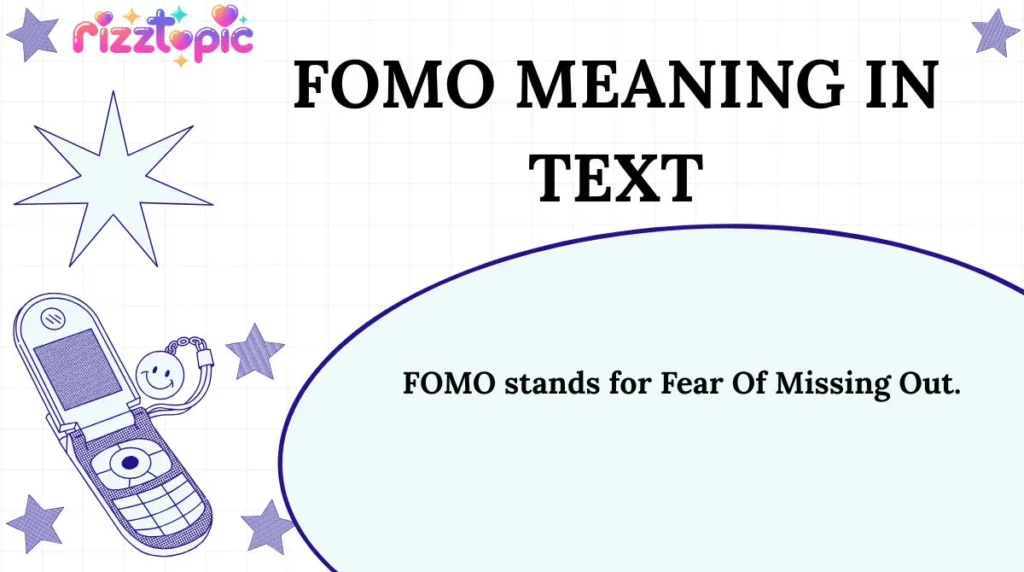
FOMO stands for Fear Of Missing Out.
In text messages and online conversations, it describes the feeling that other people are having enjoyable experiences without you. It often creates a sense of worry, curiosity, or anxiety about being left out.
The primary meaning of FOMO is the fear that you are missing something exciting, important, or fun.
Primary Meaning
- Fear Of Missing Out
- Feeling excluded from events or experiences
- Worry that others are having a better time
Secondary Meanings
Depending on the conversation, FOMO can also refer to:
- Missing online trends
- Missing social gatherings
- Missing important opportunities
- Missing special offers or sales
- Missing news or updates
Quick Examples
- “Everyone is going to the concert. I have major FOMO.”
- “Seeing those vacation pictures gave me FOMO.”
- “I joined because I didn’t want FOMO.”
Background & Origin of FOMO
The phrase “Fear Of Missing Out” existed before social media became popular. However, the abbreviation FOMO gained widespread attention during the rise of platforms like Facebook, Instagram, and Twitter.
Researchers and marketers noticed that many people felt pressure to stay connected because they feared missing exciting experiences. As social networking grew, users constantly saw photos, updates, and stories from friends.
This made the feeling of missing out more visible than ever before.
The term became especially popular in the 2010s when smartphones allowed people to check social media at any time. Today, FOMO is recognized worldwide and is commonly used in both casual and professional settings.
Example
- Before social media: Missing a party meant you might never know what happened.
- Today: You can instantly see photos, videos, and updates, which can increase FOMO.
Usage in Different Contexts
FOMO is not limited to personal chats. People use it in many different situations.
In Text Messages
Friends use it when they feel left out.
Examples:
- “You all went without me? FOMO!”
- “Now I’m getting FOMO from your photos.”
On Social Media
Users mention FOMO when seeing exciting content.
Examples:
- “This festival looks amazing. FOMO is real.”
- “Everyone is traveling this summer.”
In Marketing
Businesses use FOMO to encourage purchases.
Examples:
- Limited-time offers
- Flash sales
- Exclusive memberships
In Workplaces
Professionals may use FOMO when discussing opportunities.
Examples:
- Missing networking events
- Missing training sessions
- Missing industry updates
Meanings Across Platforms
Different social platforms use FOMO in similar ways, but the context may vary.
Usually appears in group chats.
Examples:
- “Looks fun. I have FOMO already.”
- “Wish I could join.”
Often linked to photos and stories.
Examples:
- Travel pictures
- Event highlights
- Lifestyle content
TikTok
Frequently connected to viral trends.
Examples:
- Trending challenges
- Popular videos
- New creators
Snapchat
Mostly related to social activities.
Examples:
- Friends hanging out
- Exclusive moments
- Party snaps
Common Platform Usage
- WhatsApp → group activities
- Instagram → lifestyle updates
- TikTok → trends and viral content
- Snapchat → real-time social moments
Other Fields and Alternative Meanings
Although FOMO usually means Fear Of Missing Out, it can occasionally have different meanings in specialized fields.
Psychology
A recognized social and emotional phenomenon connected to social comparison.
Marketing
A strategy used to encourage quick action.
Business
Refers to hesitation caused by fear of missing opportunities.
Technology
Sometimes discussed when talking about digital habits and social media behavior.
Important Note
In everyday texting, FOMO almost always means Fear Of Missing Out rather than a technical or professional definition.
Common Misconceptions & Mistakes
Many people misunderstand how FOMO is used.
Mistake 1: Thinking It Means Jealousy
FOMO and jealousy are not identical.
Someone can feel FOMO without being jealous.
Mistake 2: Using It for Every Missed Event
FOMO usually involves a strong feeling of missing something meaningful or exciting.
Mistake 3: Assuming It’s Negative
FOMO can be playful and humorous.
Example:
- “I saw the pizza pictures and got instant FOMO 😂”
Mistake 4: Writing It Incorrectly
Correct form:
- FOMO
Less common:
- fomo
Similar Terms & Alternatives
| Term | Meaning |
|---|---|
| FOMO | Fear Of Missing Out |
| YOLO | You Only Live Once |
| JOMO | Joy Of Missing Out |
| OMO | Fear of Missing Out Variant |
| Peer Pressure | Feeling influenced by others |
| Social Anxiety | Anxiety in social situations |
| Hype | Excitement around something |
| Trend Chasing | Following popular trends |
How to Respond to FOMO in Text
When someone says they have FOMO, you can respond casually and naturally.
Friendly Responses
- “You should come next time!”
- “We’ll save you a spot 😊”
- “Don’t worry, we’ll do it again.”
- “You didn’t miss much honestly.”
Chat Examples
Example 1
Friend: “I’m getting FOMO from these pictures.”
Reply: “You need to join us next time 😄”
Example 2
Friend: “Major FOMO right now.”
Reply: “We’ll plan another one soon!”
Example 3
Friend: “Looks so fun.”
Reply: “Wish you were here 😊”
Example 4
Friend: “FOMO is hitting hard.”
Reply: “We’re definitely inviting you next time.”
Differences From Similar Words
People often confuse FOMO with related expressions.
FOMO vs Jealousy
- FOMO = Fear of missing experiences.
- Jealousy = Wanting what someone else has.
FOMO vs Envy
- FOMO focuses on experiences.
- Envy focuses on possessions or achievements.
FOMO vs JOMO
- FOMO = Fear of Missing Out.
- JOMO = Joy of Missing Out.
JOMO describes being happy staying home and not participating.
Relevance in Online Conversations & Dating Apps
FOMO is extremely common on dating apps and social platforms.
People often use it when:
- Missing matches
- Missing social events
- Seeing others on dates
- Watching friends enjoy relationships
Dating App Examples
- “Seeing everyone’s date pictures gives me FOMO.”
- “I almost deleted the app because of FOMO.”
- “I didn’t want to miss meeting new people.”
The term helps people express emotions quickly without writing long explanations.
Popularity & Trends Over Time
FOMO became increasingly popular alongside social media growth.
Search interest has remained strong because:
- More people use messaging apps.
- Social media continues to expand.
- Online communities create constant updates.
- Digital lifestyles increase social comparison.
Why People Search It
- They see it in texts.
- They encounter it on TikTok.
- Friends use it in chats.
- Influencers mention it online.
Today, FOMO remains one of the most recognized internet abbreviations.
FAQs
What does FOMO mean in text?
FOMO means Fear Of Missing Out. It describes feeling worried that others are enjoying something without you.
Is FOMO a positive or negative term?
It can be either. Sometimes it expresses genuine anxiety, while other times it is used jokingly.
What is the opposite of FOMO?
The opposite is JOMO, which stands for Joy Of Missing Out.
Why do people say FOMO online?
People use it to describe feeling left out of events, trends, conversations, or experiences.
Is FOMO used on Instagram and TikTok?
Yes. It is commonly used on Instagram, TikTok, Snapchat, WhatsApp, and many other social platforms.
Can FOMO affect mental health?
In some cases, excessive FOMO may contribute to stress, anxiety, or social comparison.
Is FOMO only used by young people?
No. People of all ages use the term in both personal and professional conversations.
Conclusion
The FOMO meaning in text is simple yet highly relevant in today’s digital world. It stands for Fear Of Missing Out and describes the feeling that others may be enjoying experiences, opportunities, or events without you.
The term has become a common part of online communication because it quickly expresses emotions that many people experience.
Whether it appears in a group chat, social media post, or workplace discussion, FOMO is widely understood.
Understanding FOMO can help you follow online conversations more easily and communicate naturally with friends, coworkers, and online communities.
As social media continues to shape communication, this popular abbreviation is likely to remain part of internet culture for years to come.