If you spend time texting, scrolling through social media, or chatting online, you have probably come across the term IMAO.
Many people search for “IMAO meaning in text” because internet slang changes quickly, and it can be hard to keep up with new abbreviations.
Understanding online acronyms helps you communicate better and avoid confusion in conversations.
Whether you see IMAO in a text message, a meme, or a social media comment, knowing its meaning can make interactions much easier.
The term is often used in casual conversations to express an opinion, reaction, or humorous thought. While it looks similar to several other internet abbreviations, it has its own unique meaning and purpose.
In this guide, you’ll learn what IMAO means, where it came from, how people use it across platforms, and how to respond when someone uses it in a conversation.
Meaning & Definition of IMAO
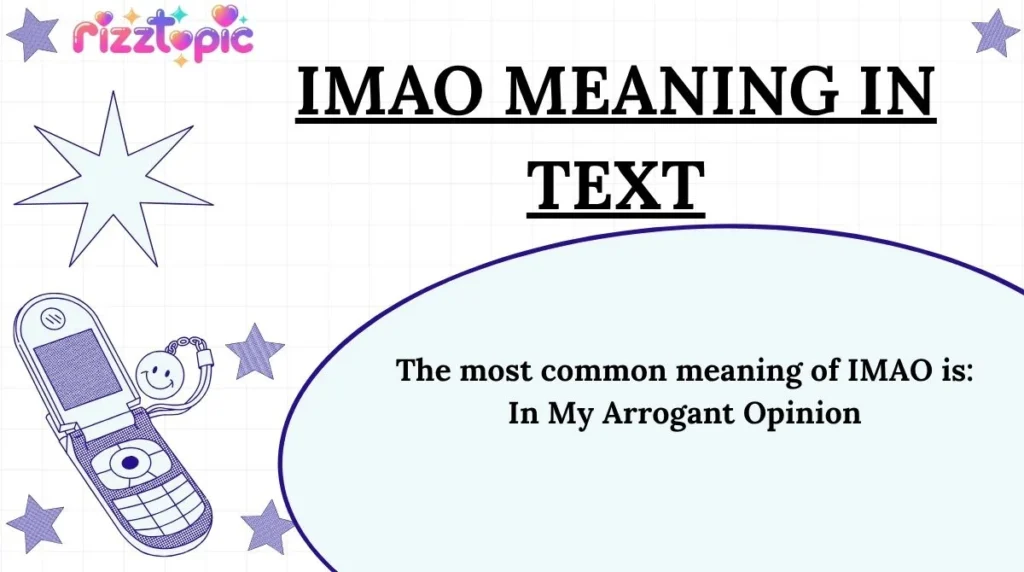
The most common meaning of IMAO is:
In My Arrogant Opinion
People use this phrase when sharing an opinion that may sound overly confident, bold, or sarcastic. In many cases, it is used humorously rather than seriously.
Primary Meaning
- IMAO = In My Arrogant Opinion
- Used to express a strong personal opinion.
- Often carries a playful or sarcastic tone.
Example
- “IMAO, that was the best movie released this year.”
In this example, the speaker jokingly suggests that their opinion is very confident or perhaps a little arrogant.
Secondary Meaning
Sometimes people mistakenly use IMAO when they actually mean LMAO (“Laughing My Ass Off”). Because the two abbreviations look similar, confusion happens frequently.
Quick Examples
- “IMAO, pineapple belongs on pizza.”
- “That game was overrated, IMAO.”
- “IMAO, this update is much better.”
- “You should try that restaurant, IMAO.”
The exact meaning usually depends on the tone and context of the conversation.
Background & Origin of IMAO
Like many internet abbreviations, IMAO emerged from early online chat rooms, forums, and instant messaging platforms. During the late 1990s and early 2000s, internet users created shorter versions of common phrases to type faster.
As online communities grew, acronyms became a normal part of digital communication. Terms such as LOL, BRB, IMO, and IMAO gained popularity among users who wanted quick ways to express emotions and opinions.
IMAO developed as a humorous variation of IMO, which means “In My Opinion.” By replacing “Opinion” with “Arrogant Opinion,” users added a layer of self-aware humor.
The phrase became especially popular on message boards where people debated movies, sports, technology, and entertainment. Writers often used it to soften strong opinions by showing they were joking about being overly confident.
Historical Usage Examples
- Online gaming forums
- Internet discussion boards
- Early messaging applications
- Social networking websites
Today, IMAO remains part of internet slang, although it is less common than acronyms like LOL, IMO, or LMAO.
Usage in Different Contexts
IMAO can appear in many forms of online communication. The tone usually depends on the relationship between participants and the platform being used.
Text Messaging
Friends often use IMAO when sharing personal opinions.
Example:
- “IMAO, that new phone isn’t worth the price.”
Social Media
Users add IMAO to comments, captions, and discussions.
Example:
- “IMAO, this trend won’t last very long.”
Gaming Communities
Players often debate game updates and rankings.
Example:
- “IMAO, this character is the strongest in the game.”
Online Forums
Forum members use it when discussing controversial topics.
Example:
- “IMAO, the older version worked better.”
Workplace Conversations
IMAO is generally not recommended in professional communication because it can appear sarcastic or unprofessional.
Instead, phrases like:
- “In my opinion”
- “I believe”
- “From my perspective”
are safer choices.
Meanings Across Platforms
Different platforms influence how people use internet slang. The meaning of IMAO generally stays the same, but the tone can vary.
On WhatsApp, IMAO is often used in friendly chats.
Example:
- “IMAO, we should leave earlier tomorrow.”
Instagram users may place it in captions or comments.
Example:
- “IMAO, this outfit is the best one here.”
TikTok
TikTok users often use IMAO when reacting to videos or trends.
Example:
- “IMAO, this challenge is actually fun.”
Snapchat
On Snapchat, the acronym appears in quick conversations among friends.
Example:
- “IMAO, that filter looks hilarious.”
X (Twitter)
Users frequently add IMAO to opinions about current events, sports, or entertainment.
Example:
- “IMAO, that was the best performance tonight.”
Other Fields: Technical, Medical, and Specialized Meanings
While IMAO is mainly known as internet slang, abbreviations can sometimes have different meanings in specialized fields.
Medical Field
IMAO is occasionally associated with translated or regional references to certain medication categories. However, this usage is uncommon in English-speaking medical communication.
Technical Fields
In technology and engineering, IMAO rarely appears as a standard abbreviation. Most technical professionals interpret it as internet slang unless defined otherwise.
Aviation
There is no widely recognized aviation meaning for IMAO.
Scientific Usage
Scientific literature generally does not use IMAO as a standard acronym.
Because specialized meanings are rare, the internet slang interpretation is usually the correct one when encountered online.
Common Misconceptions & Mistakes
Many people misunderstand IMAO because it closely resembles other internet abbreviations.
Mistake 1: Confusing It With LMAO
Wrong:
- Assuming IMAO means laughter.
Correct:
- IMAO usually means “In My Arrogant Opinion.”
Mistake 2: Thinking It Is Offensive
Although “arrogant” sounds negative, users often employ the phrase jokingly.
Mistake 3: Using It Professionally
Business emails and formal documents should avoid internet slang.
Mistake 4: Assuming Everyone Knows It
Not all users recognize the acronym, especially older audiences.
Quick Tips
- Use it in casual conversations.
- Consider the audience.
- Avoid professional settings.
- Check context before interpreting it.
Similar Terms & Alternatives
| Term | Meaning | Usage |
|---|---|---|
| IMO | In My Opinion | Neutral opinion |
| IMHO | In My Humble Opinion | Polite opinion |
| IMAO | In My Arrogant Opinion | Humorous opinion |
| LMAO | Laughing My Ass Off | Strong laughter |
| LOL | Laugh Out Loud | General laughter |
| TBH | To Be Honest | Honest statement |
| FYI | For Your Information | Sharing information |
These abbreviations often appear together in online discussions.
How to Respond to IMAO
When someone uses IMAO, your response depends on the conversation’s tone.
Agreeing
- “You’re probably right 😂”
- “I agree with that.”
- “That’s a fair point.”
Disagreeing
- “Maybe, but I see it differently.”
- “Interesting take 😄”
- “I don’t completely agree.”
Chat Examples
Person A: IMAO, that movie deserved an award.
Person B: I agree! It was amazing. 😊
Person A: IMAO, summer is the best season.
Person B: Winter wins for me. 😂
Person A: IMAO, this game is overrated.
Person B: Really? I actually love it.
Person A: IMAO, pizza beats burgers.
Person B: That’s a tough debate! 🍕
Differences From Similar Words
Understanding the difference between IMAO and similar abbreviations prevents misunderstandings.
IMAO vs IMO
- IMO = Neutral opinion.
- IMAO = Opinion with humor or exaggerated confidence.
IMAO vs IMHO
- IMHO sounds modest.
- IMAO sounds intentionally bold.
IMAO vs LMAO
- IMAO expresses an opinion.
- LMAO expresses laughter.
Example Comparison
- “IMO, this phone is good.”
- “IMHO, this phone is good.”
- “IMAO, this phone is the best ever.”
Each phrase creates a different tone.
Relevance in Online Conversations & Dating Apps
IMAO remains useful in modern digital communication because people enjoy expressing opinions in a fun and informal way.
Dating Apps
Users may use IMAO while discussing:
- Favorite movies
- Travel destinations
- Food preferences
- Music tastes
Example:
- “IMAO, coffee dates are better than dinner dates.”
Online Communities
People use it to:
- Share viewpoints
- Start discussions
- Create humorous debates
- Add personality to messages
The acronym helps conversations feel more relaxed and engaging.
Popularity & Trends Over Time
IMAO has never reached the popularity level of abbreviations like LOL or LMAO, but it has maintained a presence in online culture.
Over time, internet users have increasingly favored emojis, GIFs, and memes to express emotions. As a result, some older acronyms are used less frequently than before.
Trends Observed
- Popular in early internet forums.
- Common in gaming communities.
- Still appears on social media.
- Less common than LOL and IMO.
- Often used humorously rather than seriously.
Search interest generally spikes when users encounter the acronym for the first time and want to understand its meaning.
FAQs
What does IMAO mean in text messages?
IMAO usually means “In My Arrogant Opinion.” It is used to share a strong or humorous opinion.
Is IMAO the same as LMAO?
No. IMAO expresses an opinion, while LMAO means someone is laughing very hard.
Is IMAO rude?
Not usually. Most people use it jokingly and not as a serious insult.
Can I use IMAO at work?
It is better to avoid internet slang in professional communication.
What is the difference between IMO and IMAO?
IMO means “In My Opinion,” while IMAO means “In My Arrogant Opinion.”
Why do people use IMAO?
People use it to add humor, confidence, or personality to their opinions.
Is IMAO still popular?
It is still used online, though it is less common than many mainstream internet abbreviations.
Conclusion
IMAO is a popular internet acronym that stands for “In My Arrogant Opinion.” It allows people to express strong opinions in a playful and often humorous way.
Although it may sound serious at first glance, most users employ it jokingly.
The term originated from early online communities and continues to appear in text messages, social media comments, gaming discussions, and casual chats.
Understanding its meaning helps you interpret online conversations more accurately.
While IMAO is suitable for informal communication, it is generally best to avoid it in professional settings. Context remains important, especially because some people may confuse it with other abbreviations like LMAO or IMO.
As internet language continues to evolve, knowing terms like IMAO can help you stay connected, understand digital culture, and communicate more confidently online.