People often come across internet slang while texting, scrolling social media, or chatting online.
One abbreviation that appears frequently is STFU, and many users search for its meaning after seeing it in messages, comments, or memes.
Understanding online abbreviations helps people communicate better and avoid misunderstandings.
Some acronyms are harmless and funny, while others can sound rude depending on the situation. STFU falls into the second category because its tone can vary widely.
Whether you spotted it on TikTok, WhatsApp, Instagram, Snapchat, or a gaming platform, knowing what STFU means can help you understand the message and respond appropriately.
This guide explains the meaning, origin, usage, alternatives, and common mistakes associated with this popular internet abbreviation.
Meaning & Definition of STFU
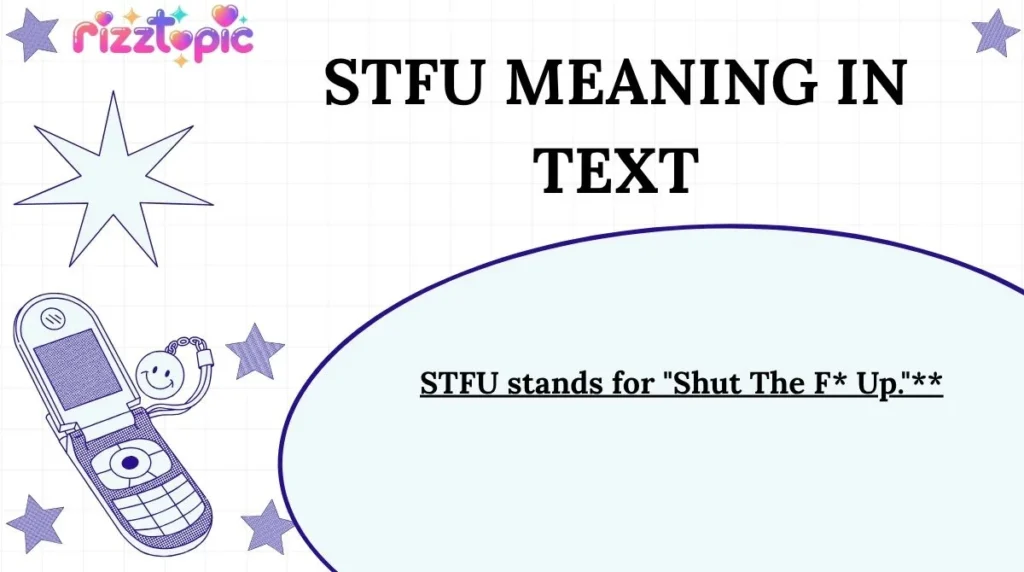
STFU stands for “Shut The F* Up.”**
It is a slang abbreviation used in text messages, social media posts, online gaming, and internet conversations. The phrase is usually intended to tell someone to stop talking or stop saying something.
Primary Meaning
The most common meaning is:
- “Be quiet.”
- “Stop talking.”
- “I don’t want to hear this anymore.”
Secondary Meanings
Depending on context, STFU can also mean:
- Surprise or disbelief
- Playful joking between friends
- Excitement about unexpected news
- Friendly teasing
Examples
- “STFU, did you really win the lottery?”
- “STFU 😂 That’s the funniest thing I’ve heard today.”
- “Please STFU and let me finish.”
The tone depends entirely on the relationship between the people involved and the situation.
Background & Origin
STFU became popular during the early days of internet forums, chat rooms, and online gaming communities. As users looked for quicker ways to communicate, abbreviations such as LOL, BRB, OMG, and STFU became common.
The phrase itself existed long before the internet. However, shortening it to STFU made typing faster in online conversations.
As social media platforms grew, the abbreviation spread across:
- Online forums
- Gaming communities
- Text messaging
- Social media comments
- Meme culture
Today, STFU is recognized globally and is one of the most widely used slang acronyms online.
Because it contains a profanity, many people consider it stronger and more aggressive than simply saying “be quiet.”
Usage in Different Contexts
STFU can have different meanings depending on where and how it is used.
Casual Chats
Friends may use it jokingly.
Example:
- “STFU 😂 No way that happened!”
Gaming
Players may use it during competitive matches.
Example:
- “STFU and focus on the objective.”
Social Media
People often use it to react to shocking news.
Example:
- “STFU! I can’t believe they announced that.”
Arguments
In heated discussions, STFU is usually meant literally and may sound offensive.
Example:
- “Just STFU already.”
Quick Examples
- Funny reaction
- Shock or surprise
- Frustration
- Friendly teasing
- Direct insult
Always pay attention to the context before interpreting the message.
Meanings Across Platforms
On WhatsApp, STFU is often used between friends during casual conversations.
Example:
- “STFU 😭 You’re joking!”
Instagram users commonly use STFU in comments and direct messages.
Example:
- “STFU, this outfit is amazing!”
TikTok
TikTok users often use STFU to express excitement or disbelief.
Example:
- “STFU! This story is confused.”
Snapchat
On Snapchat, STFU is usually used in quick, informal chats.
Example:
- “STFU 😂 Send me proof.”
Although the abbreviation stays the same, the emotional tone can change across platforms.
Other Fields and Technical Meanings
While STFU is primarily internet slang, abbreviations can sometimes have different meanings in specialized industries.
Some organizations or technical groups may use STFU as an internal acronym. However, there is no universally accepted technical meaning that is as common as the slang version.
In most situations, if someone writes STFU online, they are referring to:
Shut The F* Up**
Not a medical, scientific, aircraft, or engineering term.
Always use context to determine the intended meaning.
Common Misconceptions & Mistakes
Many people misunderstand STFU because they assume it always means the same thing.
Common Mistakes
Mistake 1: Thinking it is always rude.
Reality:
Friends often use it jokingly.
Mistake 2: Using it in professional settings.
Reality:
It is generally inappropriate for workplace communication.
Mistake 3: Assuming everyone finds it funny.
Reality:
Some people may view it as offensive.
Mistake 4: Using it with strangers.
Reality:
Without context, it can create conflict.
Understanding the audience is important before using slang expressions like STFU.
Similar Terms & Alternatives
| Term | Meaning | Tone |
|---|---|---|
| STFU | Shut The F*** Up | Strong |
| Be Quiet | Stop talking | Polite |
| Hush | Be silent | Gentle |
| Shh | Quiet down | Friendly |
| Zip It | Stop talking | Casual |
| Calm Down | Relax | Neutral |
| Hold On | Wait a moment | Polite |
| Stop Talking | Direct request | Moderate |
Choosing a softer alternative is often better in formal situations.
How to Respond to STFU
The best response depends on whether the message is serious or playful.
If It Is a Joke
- “😂 You’re hilarious.”
- “I know, right?”
- “Can’t believe it either!”
If It Is Surprise
- “It’s true!”
- “I have proof.”
- “No joke!”
If It Is Rude
- “Let’s keep the conversation respectful.”
- “No need for that.”
- “Let’s move on.”
Chat-Style Examples
Friend: STFU 😂 You met your favorite singer?
You: Yes! It was amazing 😍
Friend: STFU, no way!
You: I swear it’s true 😂
Person: STFU already.
You: Let’s keep things respectful.
Friend: STFU 😭 That’s wild!
You: I couldn’t believe it either!
Differences From Similar Words
Many people confuse STFU with other expressions.
STFU vs Shh
- STFU is stronger and often contains frustration.
- Shh is softer and more polite.
STFU vs Be Quiet
- STFU sounds aggressive.
- Be quiet sounds more respectful.
STFU vs Calm Down
- STFU targets speech.
- Calm down targets emotions.
STFU vs Hush
- Hush is gentle.
- STFU is blunt.
Understanding these differences helps prevent accidental offense.
Relevance in Online Conversations & Dating Apps
STFU appears frequently on dating apps, social platforms, and messaging services.
In dating conversations, it is often used as a reaction to exciting news rather than an insult.
Examples:
- “STFU 😍 You’re actually coming to my city?”
- “STFU 😂 We have the same birthday!”
However, using it too early with someone new can create a negative impression.
Dating app users should be careful because humor does not always translate well through text.
A phrase intended as playful may be interpreted as rude by someone who does not know your personality.
Popularity & Trends Over Time
STFU has remained popular for many years because internet slang evolves slowly when a term becomes widely recognized.
According to search behavior and social media usage trends, interest in STFU increases when:
- Viral memes spread
- New social media users join platforms
- People encounter unfamiliar abbreviations
- Online slang becomes a trending topic
The acronym continues to appear across:
- TikTok videos
- Instagram comments
- Snapchat conversations
- Gaming communities
- Online forums
Even as new slang emerges, STFU remains one of the most recognized internet abbreviations.
FAQs
What does STFU mean in text?
STFU stands for “Shut The F* Up.”** It is commonly used in texting and online conversations.
Is STFU offensive?
It can be. The phrase contains profanity and may sound rude depending on context and tone.
What does STFU mean from a friend?
Friends often use it jokingly to express shock, excitement, or disbelief.
Can STFU be used professionally?
No. It is generally inappropriate for workplace communication.
What does STFU mean on TikTok?
On TikTok, it often expresses surprise, excitement, or reaction to unexpected content.
What does STFU mean on Snapchat?
It usually appears in casual conversations and often carries a playful tone.
Is STFU the same as saying “be quiet”?
Not exactly. STFU is much stronger and can sound more aggressive.
Why do people use STFU online?
People use it to react to shocking news, joke with friends, express frustration, or tell someone to stop talking.
Conclusion
STFU is one of the most recognizable internet abbreviations and stands for “Shut The F* Up.”**
While its literal meaning can sound harsh, the phrase often takes on different tones depending on the relationship between the people involved.
In modern texting, social media, and online communities, STFU is frequently used as a reaction to surprising, funny, or unbelievable information. Context plays a huge role in determining whether the message is playful or offensive.
Before using the term, consider your audience and the situation. Friends may interpret it as humor, while strangers or professional contacts may view it negatively.
Understanding the meaning, usage, and tone of STFU helps you communicate more effectively in today’s digital world.
Meta Description: .